
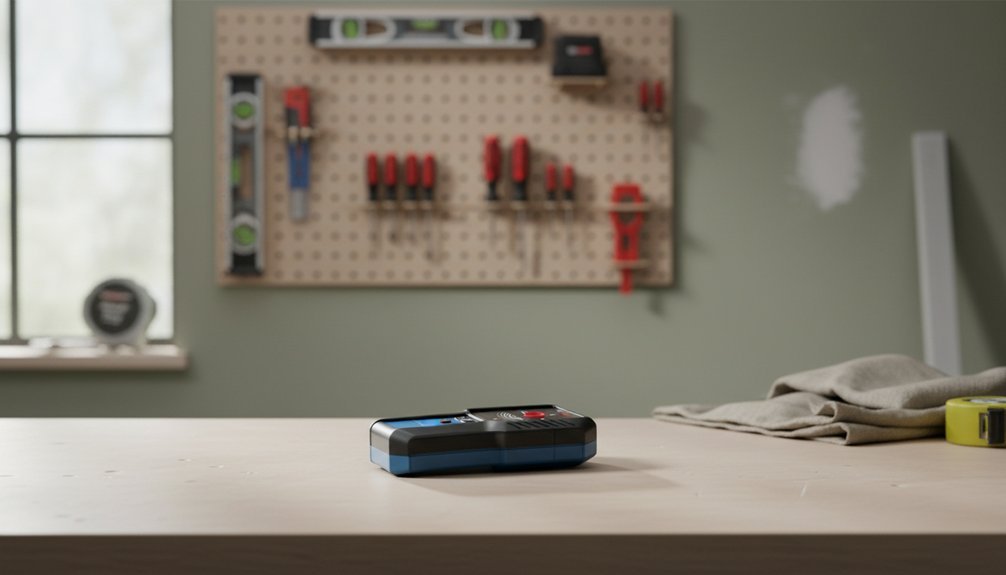
You’ll get reliable stud, metal, and live wire detection with tools like the Bosch GMS120-27, featuring color-coded LEDs and center targeting for quick navigation behind walls.
Models such as the FNIRSI 6-in-1 offer depth scanning up to 4.7” and auto-calibration, while the Franklin ProSensor MAX uses 13 sensors for high accuracy on thick surfaces.
Rechargeable options like the FNIRSI WD-02 include TFT screens and audio alerts, though battery-powered units remain dependable.
Each model balances power, precision, and usability—especially on drywall, plaster, or tile—and choosing the right one depends on your project’s demands and wall complexity.
There’s more to unpack about which features truly make a difference when you go deeper into the details.
| Bosch GMS120-27 Wall Scanner |  | Best Overall | Detection Types: Wood studs, metal studs, live wires | Detection Depth: Up to 1.5 inches (wood/metal), 2 inches (wires) | Display Type: LED indicators with color-coded marking | VIEW LATEST PRICE | Read Our Analysis |
| FNIRSI WD-02 Stud Finder with TFT Display |  | Budget-Friendly Pick | Detection Types: Wood studs, metal studs, AC wires, pipes | Detection Depth: 1.5 cm (studs), 4.7 cm (metal), 2 cm (AC wire) | Display Type: TFT digital LCD display | VIEW LATEST PRICE | Read Our Analysis |
| Stud Finder Wall Scanner 5-in-1 |  | Best For DIYers | Detection Types: Wood studs, metal studs, pipes, live AC wires | Detection Depth: Up to 38 mm (studs), 60 mm (metal), 51 mm (AC wires) | Display Type: Backlit HD LCD | VIEW LATEST PRICE | Read Our Analysis |
| Stud Finder Wall Scanner with HD LCD |  | Best Value | Detection Types: Wood studs, metal studs, pipes, live AC wires | Detection Depth: Up to 38 mm (studs), deeper for pipes and wide studs | Display Type: Backlit HD LCD | VIEW LATEST PRICE | Read Our Analysis |
| FNIRSI 6-in-1 Wall Stud Finder Scanner |  | Most Features | Detection Types: Wood studs, metal studs, ferrous/non-ferrous metals, copper wire, AC wires | Detection Depth: 0.75″ (standard), 1.5″ (deep), 3.9″ (copper), 4.7″ (ferrous) | Display Type: Digital LCD display | VIEW LATEST PRICE | Read Our Analysis |
| Zircon StudSensor A100 Stud Finder |  | Best For Beginners | Detection Types: Wood/metal studs, live AC wires | Detection Depth: 0.75 inch (studs), 2 inches (AC wires) | Display Type: Easy-to-read display with audio indicators | VIEW LATEST PRICE | Read Our Analysis |
| Franklin ProSensor MAX Stud Finder |  | Professional Grade | Detection Types: Wood/metal studs, multiple drywall layers, lath, plaster, tile | Detection Depth: 2.5 inches maximum | Display Type: Precision LED array | VIEW LATEST PRICE | Read Our Analysis |
| Stud Finder Wall Scanner 5-in-1 |  | Editor’s Choice | Detection Types: Wood studs, metal studs, pipes, rebar, live AC wires | Detection Depth: 1.5 inch (studs), 2.36 inch (metal), 2 inch (AC wires) | Display Type: Large HD LCD display | VIEW LATEST PRICE | Read Our Analysis |
More Details on Our Top Picks
Bosch GMS120-27 Wall Scanner
If you’re tackling drywall projects that demand precision, the Bosch GMS120-27 Wall Scanner is a smart choice, especially for DIYers and pros who need reliable stud detection without guesswork. You’ll quickly locate live wires, metal, wood, or steel studs behind walls with its color-coded LEDs and center indication. The marking hole makes layout easy, while clear results reduce errors. It’s built tough with an IP54 rating and shock-absorbing rubber casing. You can use AA batteries or a 3.7 V Li-ion (sold separately) to keep going. It includes a one-year warranty, extendable to two with registration.
- Detection Types:Wood studs, metal studs, live wires
- Detection Depth:Up to 1.5 inches (wood/metal), 2 inches (wires)
- Display Type:LED indicators with color-coded marking
- Power Source:AA batteries or optional 3.7V Li-ion
- Alert Type:Color-coded LEDs
- Calibration:Not specified (assumed manual)
- Additional Feature:IP54 rated protection
- Additional Feature:Shock-absorbing rubber casing
- Additional Feature:Dual power compatibility
FNIRSI WD-02 Stud Finder with TFT Display
The FNIRSI WD-02 Stud Finder with TFT Display gives DIYers and contractors alike a clear edge when precision matters, especially on complex jobs involving mixed materials. You’ll appreciate its three detection modes—studs, metal, and AC wires—each with adjustable sensitivity. It finds wood and metal studs, pipes, and live wiring, though stud depth is limited to 1.5 cm. The TFT screen shows exact locations, while audio alerts confirm finds. With a rechargeable design and HPC chip, it’s reliable and smart. The positioning hole helps you mark centers and edges quickly. Auto-calibration simplifies use across walls, ceilings, and floors—even over wallpaper or lath.
- Detection Types:Wood studs, metal studs, AC wires, pipes
- Detection Depth:1.5 cm (studs), 4.7 cm (metal), 2 cm (AC wire)
- Display Type:TFT digital LCD display
- Power Source:Rechargeable
- Alert Type:Audio alarm and visual display
- Calibration:Auto-calibration
- Additional Feature:TFT digital display
- Additional Feature:HPC chip enhanced
- Additional Feature:Auto-calibration function
Stud Finder Wall Scanner 5-in-1
You’ll get the most out of this Stud Finder Wall Scanner 5-in-1 if you’re a DIYer or tradesperson who tackles wall projects regularly, since its intelligent micro-sensor chip delivers fast, reliable detection of wood and metal studs, joists, pipes, and live AC wiring. You’ll switch between Stud, Deep, and Metal Scan modes to find exactly what’s behind walls, floors, or ceilings, up to useful depths. The bright backlit LCD and audio alerts make locating studs easy, even in low light. You’ll appreciate the clear visuals and beeps when hanging TVs, shelves, or cabinets. It’s a smart gift that prevents drilling into wires or pipes, saving repairs. While not foolproof on thick walls, it’s accurate enough for most jobs—simple, safe, and efficient.
- Detection Types:Wood studs, metal studs, pipes, live AC wires
- Detection Depth:Up to 38 mm (studs), 60 mm (metal), 51 mm (AC wires)
- Display Type:Backlit HD LCD
- Power Source:Battery-powered (type unspecified)
- Alert Type:Audio alerts and beeps with visual display
- Calibration:Not specified
- Additional Feature:Intelligent micro-sensor chip
- Additional Feature:Backlit HD LCD
- Additional Feature:Low-light operation capable
Stud Finder Wall Scanner with HD LCD
Spotting hidden studs and live wires just got easier with a Stud Finder Wall Scanner featuring an HD LCD display, ideal for DIYers and pros who want precision without the guesswork. You’ll see stud centers, edges, and object types clearly on the bright, backlit screen, plus get audio cues for exact locations. Its 5-in-1 function detects wood and metal studs, joists, pipes, and live AC wires using smart micro-sensor tech that’s both fast and reliable. Switch between Stud, Deep, and Metal Scan modes depending on your project. Whether mounting a TV or installing shelves, it works on walls, floors, and ceilings—helping you avoid costly mistakes.
- Detection Types:Wood studs, metal studs, pipes, live AC wires
- Detection Depth:Up to 38 mm (studs), deeper for pipes and wide studs
- Display Type:Backlit HD LCD
- Power Source:Battery-powered (type unspecified)
- Alert Type:Audio beeps with visual display
- Calibration:Not specified
- Additional Feature:Bright backlit display
- Additional Feature:Audio-guided detection
- Additional Feature:Multi-surface scanning
FNIRSI 6-in-1 Wall Stud Finder Scanner
Looking for a stud finder that keeps up with both weekend DIYers and seasoned pros? The FNIRSI 6-in-1 Wall Stud Finder Scanner’s got you covered. It detects wood, metal studs, live AC wires, and copper pipes with impressive depth—up to 4.7″ for iron and 3.9″ for copper. Its exact and depth scan modes let you choose precision or deeper reach. You’ll love the clear LCD display and handy audio alerts that confirm detections. The built-in positioning hole makes marking stud edges and centers fast and accurate. It auto-calibrates in one step, works on painted walls, wallpaper, even acoustic ceilings, and recharges instead of relying on replaceable batteries—so you’re not caught mid-job with dead power.
- Detection Types:Wood studs, metal studs, ferrous/non-ferrous metals, copper wire, AC wires
- Detection Depth:0.75″ (standard), 1.5″ (deep), 3.9″ (copper), 4.7″ (ferrous)
- Display Type:Digital LCD display
- Power Source:Rechargeable
- Alert Type:Audio alarm and digital display
- Calibration:Auto calibration
- Additional Feature:Positioning hole included
- Additional Feature:Six detection modes
- Additional Feature:Rechargeable built-in design
Zircon StudSensor A100 Stud Finder
If you’re tackling home improvement projects that demand accurate stud and wire detection, the Zircon StudSensor A100 delivers reliable performance for both DIYers and pros. You’ll quickly locate wood and metal stud centers and edges up to 3/4 inch deep, ensuring secure mounts for TVs, shelves, or cabinets with minimal wall damage. It also detects live, unshielded AC wires up to 2 inches deep, helping you avoid dangerous electrical mistakes. The clear display and audio alerts give instant feedback in any lighting. With its contoured grip and lightweight design, it’s comfortable to use all day. You’ll need a 9V battery (not included), but once powered, it works well on flat or textured walls—making it a practical, no-fuss tool for everyday jobs.
- Detection Types:Wood/metal studs, live AC wires
- Detection Depth:0.75 inch (studs), 2 inches (AC wires)
- Display Type:Easy-to-read display with audio indicators
- Power Source:9V battery (not included)
- Alert Type:Audio indicators and visual display
- Calibration:Not specified
- Additional Feature:Contoured grip design
- Additional Feature:WireWarning technology
- Additional Feature:Compact lightweight body
Franklin ProSensor MAX Stud Finder
You’ll consistently get the most accurate results with the Franklin ProSensor MAX Stud Finder, especially if you’re tackling complex or layered walls. Its 13 sensors—way more than most models—deliver unmatched precision on thick or tricky surfaces. The wide LED array shows stud edges and center at once, so you’ll see full width, whether it’s a single stud or double. You can scan through drywall, plaster, tile, and even OSB without recalibrating. Just press and go—it works right over studs, avoiding false hits. A built-in level keeps you straight, and the pencil caddy’s a small but handy perk. Made in the USA, it’s built tough for pros, though it needs two AAs (not included).
- Detection Types:Wood/metal studs, multiple drywall layers, lath, plaster, tile
- Detection Depth:2.5 inches maximum
- Display Type:Precision LED array
- Power Source:Two AA batteries (not included)
- Alert Type:No explicit audio; visual LED array only
- Calibration:No calibration required
- Additional Feature:13-sensor wide array
- Additional Feature:No calibration needed
- Additional Feature:Built-in bubble level
Stud Finder Wall Scanner 5-in-1
When accuracy and safety matter most, the Stud Finder Wall Scanner 5-in-1 stands out for DIYers, homeowners, and pros tackling wall projects. You get five smart scan modes—StudScan, DeepScan, MetalScan, AC mode, and WireWarning—that detect wood, metal, pipes, rebar, and live AC wires up to 2.4 inches deep. Upgraded sensors give you reliable detection, showing stud edges and centers quickly on the HD LCD screen, so you avoid drilling into hazards. Beeping alerts keep your focus without eye strain. It’s battery-powered, simple to use, and perfect for mounting shelves, TVs, or cabinets. Built from years of research, this scanner balances power, safety, and ease—giving you peace of mind without complexity.
- Detection Types:Wood studs, metal studs, pipes, rebar, live AC wires
- Detection Depth:1.5 inch (studs), 2.36 inch (metal), 2 inch (AC wires)
- Display Type:Large HD LCD display
- Power Source:Battery-powered
- Alert Type:Audible alarm and visual display
- Calibration:Not specified
- Additional Feature:Upgraded sensor chips
- Additional Feature:Pencil caddy storage
- Additional Feature:WireWarning during scans
Factors to Consider When Choosing Wall Scanners for Stud Detection
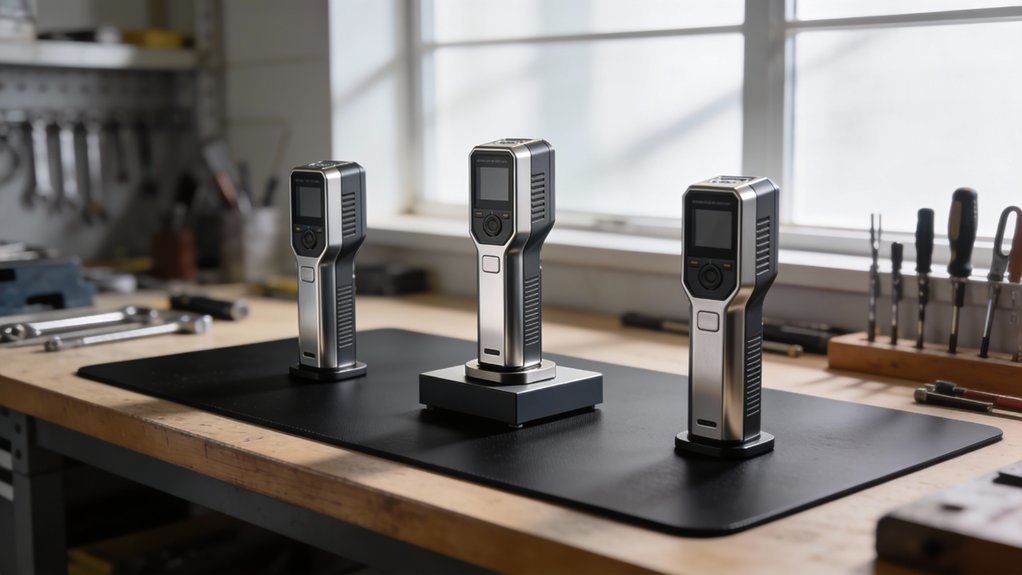
You’ll want to check a wall scanner’s detection capabilities before buying—one that spots studs, pipes, and wires saves hassle down the line. Modern sensor technology, like edge detection and dual-precision modes, boosts accuracy, but not all models handle thick drywall or deep studs equally well. Look for clear displays, a solid depth range, and reliable power options so you’re not swapping batteries mid-job.
Detection Capabilities
While wall scanners vary in performance, picking one with solid detection capabilities guarantees you find what’s hidden behind drywall without guesswork. You’ll want a model that spots wood studs, metal studs, pipes, and live AC wiring—missing any could mean hitting hazards or weak anchor points. Check the max depth each scanner handles; deeper studs or wires need stronger sensors, especially through thick plaster or tile. Look for tools that detect both stud edges and centers so you can mount securely, not just guess. Some offer color-coded readouts or labels to tell metal from wood, which cuts down mistakes. Adjusting sensitivity helps too—it tunes the scan for different wall types, so you’re not blind to subtle signals. A good scanner balances range, precision, and clarity, so you’re not left probing blindly. It won’t think for you, but it sure helps you avoid costly errors.
Sensor Technology
Though they’re often small and handheld, wall scanners rely on sophisticated sensor technology to reveal what’s hiding behind your walls. You’ll find capacitive sensors detect changes in the wall’s material, making them great for wood studs—but they can be thrown off by thick paint or damp drywall. Magnetic and Hall-effect sensors pick up nails or steel studs by spotting shifts in magnetic fields, yet they miss non-ferrous metals and wiring. For deeper insights, ultrasonic or radar-based sensors send out waves and read the echoes, helping distinguish between different materials. The best models fuse multiple sensors—capacitive, magnetic, even radar—along with smart processors to cut down false alerts. When you choose, consider how many sensing elements and how strong the processing is; more advanced chips mean clearer, more reliable readings right where you need them.
Depth Range
Depth range
Since wall construction varies widely, checking a scanner’s depth range is key to finding studs and avoiding hazards behind the surface. You’ll want to verify the max depth for different materials—wood studs, metal, non-ferrous metals, and live AC wiring—since each often has separate specs. For standard drywall, 3/4 inch to 1.5 inches covers most needs, but thicker walls or plaster demand 1.5–4+ inches. If you’re tackling older homes with lath, furring strips, or paneling, look for deep-scan or multi-layer modes. Keep in mind, deeper detection can reduce precision—positional accuracy often dips as depth increases. That’s why a clear center/edge indicator matters. Match the tool’s depth specs to your job: new builds need less range than retrofits. And always check whether depth limits are listed separately for ferrous vs. non-ferrous metals and live wires—clarity here saves guesswork and headaches.
Display Clarity
When scanning walls, a clear display makes all the difference—especially in dim basements or sunlit rooms where glare can hide key details. You’ll want a bright, high-contrast backlit LCD or TFT screen that stays readable in tough lighting. Look for models showing both stud center and edges—ideally the full width—so you’re not guessing where to drill. Clear icons for metal, live wires, and stud type help you avoid mistakes fast. Many top scanners include depth readouts in inches or millimeters, plus color-coded alerts that boost confidence. A battery indicator keeps you from being caught off guard. While audio cues help, don’t rely on them alone—especially in loud areas or if the screen’s blocked. Visual clarity should always come first. A sharp, intuitive display cuts down errors and speeds up jobs, whether you’re hanging shelves or mounting a TV. It’s a small feature that makes a big difference.
Power Source
Power source
Picking the right power source keeps your wall scanner running smoothly from first measurement to final mark. If you use a model with a built-in lithium-ion battery, you’ll get longer runtime—often 10+ hours—and skip the hassle of swapping disposables. These rechargeable units usually charge fast via USB, often in under three hours, so downtime is minimal. But if you’re on a job site far from outlets, AA or 9V-powered models let you swap in fresh batteries instead of waiting to recharge. Just keep spares on hand. Rechargeable designs tend to feel more balanced and compact, while multiple AAs or a bulky 9V can make the tool front-heavy over time. Voltage also matters—consistent power helps maintain accurate stud detection, especially during long sessions. Weaker disposable cells might cause lag or false readings near the end.
Ease of Use
Ease of Use
You’ll want a wall scanner that’s intuitive and efficient, so features like auto-calibration save time by eliminating manual setup before each use. You can start scanning mid-wall without worrying about edge-finding, which speeds things up on bigger jobs. A backlit LCD or LED array, paired with beeps, helps you read results clearly in dim corners or loud rooms. Look for center indicators or built-in marking holes—they make it easy to pencil in stud locations fast. Models with multiple scan modes let you tweak sensitivity for drywall, plaster, or thicker walls, cutting down on false hits. Most people prefer a lightweight, contoured design because it’s easier to control with one hand. You won’t get as tired during long sweeps, and steady hands mean more accurate results. These features together let you work smarter, not harder.
Durability & Build
Durability & Build
While you’re swinging from ladders and working in tight crawlspaces, your wall scanner needs to handle more than just precision—it’s got to survive the grind. Look for impact-resistant housings with rubberized bumpers; they absorb shocks when you drop the unit or bump into sharp edges. Models with IP54 or higher ratings shrug off dust and water splashes, making them reliable in messy workshops. Shock-absorbing casings or internal sensor mounts help maintain accuracy even after rough handling. Sealed buttons and ports plus reinforced battery compartments prevent failures from constant vibration. You’ll also want a lightweight, well-balanced design with a textured grip—this cuts hand fatigue during long scans and lowers slip risks. While extra durability might add a bit to the cost, it saves you money over time by reducing replacements. Trust me, a tough scanner means less worry and more done.
Conclusion
You’ve got tools that light up like a dashboard, guiding you through drywall like a pro. Some nail accuracy, while others fumble with false alarms. Digital displays help, but they can’t magic away thick paint or wonky wiring. You’ll want depth modes, edge detection, and battery life that lasts. Pick one that balances smarts and simplicity—your next project depends on it.