
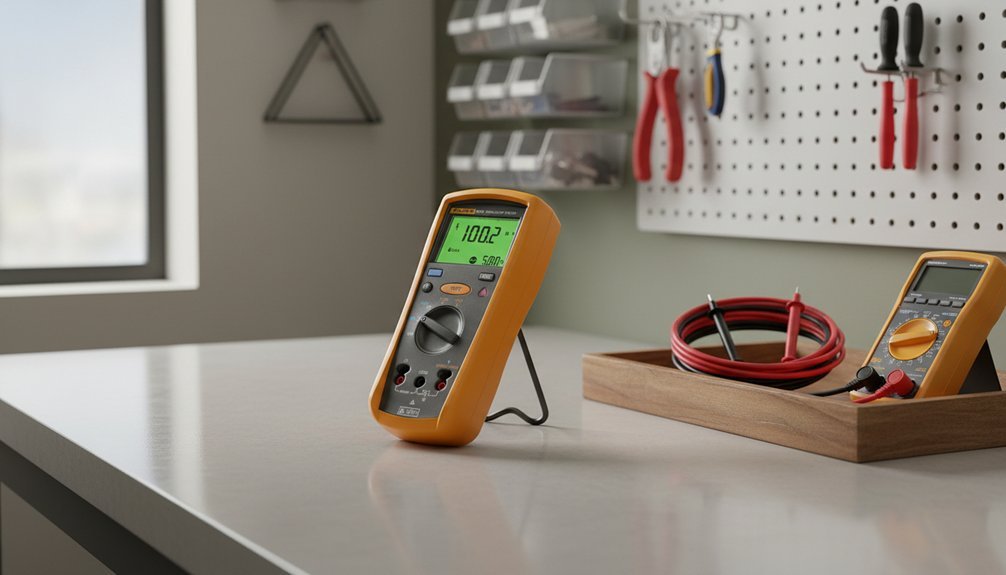
You’ll want a tester that’s safe, accurate, and built for real home electrical work. The Fluke 1503 offers CAT IV safety and auto-discharge; the M500 gives quick go/no-go results but no data logging.
Klein’s ET600 combines multimeter and insulation testing with True RMS. HIOKI’s IR4053 has fast PV-safe testing, while KAIWEETS delivers 100 GΩ range with built-in diagnostics. Each balances power, safety, and usability—perfect for checking aging wiring or new installs.
There’s more to match to your specific needs.
| Fluke 1503 Insulation Tester |  | Best Overall | Test Voltage Range: 500 V, 1000 V | Insulation Resistance Range: 0.1 MΩ to 2000 MΩ | Safety Rating: CAT IV 600 V | VIEW LATEST PRICE | Read Our Analysis |
| M500 Insulation Tester with Carrying Case |  | Budget-Friendly Pick | Test Voltage Range: 500 V AC | Insulation Resistance Range: Up to 1000 megohms | Safety Rating: Not explicitly stated | VIEW LATEST PRICE | Read Our Analysis |
| Klein Tools ET600 Multimeter & Insulation Tester |  | Editor’s Choice | Test Voltage Range: 125V, 250V, 500V, 1000V DC | Insulation Resistance Range: Up to 4000 MΩ | Safety Rating: Not explicitly stated | VIEW LATEST PRICE | Read Our Analysis |
| HIOKI Insulation Tester IR4053 |  | Professional Grade | Test Voltage Range: 50 V, 125 V, 250 V, 500 V, 1000 V | Insulation Resistance Range: Not specified, but supports high resistance under live PV | Safety Rating: CAT III 600 V | VIEW LATEST PRICE | Read Our Analysis |
| KAIWEETS Megohmmeter Insulation Tester 100GΩ | 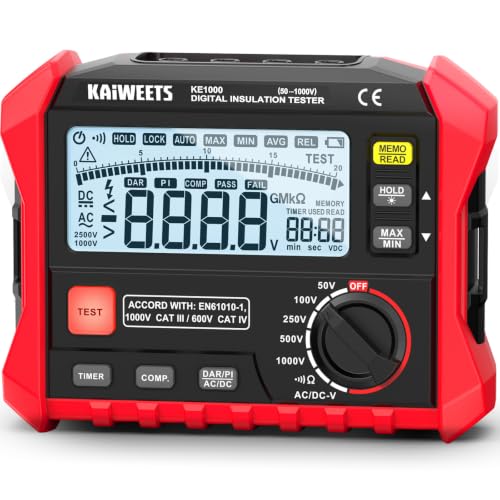 | Feature-Rich Pick | Test Voltage Range: 50V, 100V, 250V, 500V, 1000V | Insulation Resistance Range: 3.00 MΩ to 100.0 GΩ | Safety Rating: IEC 1000V CAT III / 600V CAT IV | VIEW LATEST PRICE | Read Our Analysis |
More Details on Our Top Picks
Fluke 1503 Insulation Tester
If you’re tackling home wiring safety and need reliable, professional-grade results, the Fluke 1503 Insulation Tester stands out as a smart choice. It’s compact, rugged, and simple to use—perfect for troubleshooting or routine maintenance. You’ll appreciate the remote probe for tight spots, and the 500 V or 1000 V test options give you flexibility. It safely auto-discharges capacitive voltage and won’t start if live voltage exceeds 30 V. With CAT IV 600 V safety rating and solid build, it’s made for real-world use. You get test leads, clips, and a user guide. Runs on four AA batteries—good for over 1,000 tests.
- Test Voltage Range:500 V, 1000 V
- Insulation Resistance Range:0.1 MΩ to 2000 MΩ
- Safety Rating:CAT IV 600 V
- Display Type:Large backlit display
- Auto Power Off:Auto power off to maximize battery life
- Battery Type:Four AA alkaline batteries
- Additional Feature:Remote probe included
- Additional Feature:Auto-discharge capacitive voltage
- Additional Feature:Accepts TPAK magnetic mount
M500 Insulation Tester with Carrying Case
The M500 Insulation Tester with Carrying Case stands out for HVAC technicians and electricians who need reliable, on-the-go insulation testing without sacrificing durability or ease of use. You get accurate readings up to 1000 megohms at 500V AC, perfect for checking motors, compressors, and transformers. The built-in good/normal/risk indicators simplify diagnosis, so you don’t need deep analysis on-site. Its rugged ABS housing handles drops and rough conditions, while the included soft case keeps everything organized. It runs on two C-cell batteries (not included), making field replacements easy. While it lacks advanced data logging, its straightforward design suits fast, dependable testing—ideal for both pros and serious DIYers managing home electrical safety.
- Test Voltage Range:500 V AC
- Insulation Resistance Range:Up to 1000 megohms
- Safety Rating:Not explicitly stated
- Display Type:Intuitive display with status indicators
- Auto Power Off:Not mentioned
- Battery Type:Two “C” cells (not included)
- Additional Feature:Good/Normal/Risk indicators
- Additional Feature:Double-sided ABS housing
- Additional Feature:Clear manual included
Klein Tools ET600 Multimeter & Insulation Tester
You get serious testing power in one compact tool with the Klein Tools ET600, making it a top pick for electricians and serious DIYers who want reliable home wiring safety checks. You can test insulation resistance up to 4000 MΩ at multiple voltages, giving you thorough insight into wiring condition. Its True RMS technology guarantees accurate readings, even on noisy circuits. The backlit display and bar graph help you see results clearly, while handy functions like Min/Max and Hold capture data efficiently. Voltage detection, warning alarms, and a high-voltage icon boost safety. You’ll appreciate the simple controls, replaceable fuse, and auto-power-off to save battery life.
- Test Voltage Range:125V, 250V, 500V, 1000V DC
- Insulation Resistance Range:Up to 4000 MΩ
- Safety Rating:Not explicitly stated
- Display Type:Backlit display with bar graph
- Auto Power Off:Auto-power off icon indicated
- Battery Type:Not specified
- Additional Feature:True RMS technology
- Additional Feature:Max/Min and Hold
- Additional Feature:Test and lock buttons
HIOKI Insulation Tester IR4053
Photovoltaic system owners gain peace of mind with the HIOKI Insulation Tester IR4053 because it safely measures insulation resistance even while solar panels generate power. You get accurate readings without shutting down the system or causing shorts. Its PV mode delivers results in just 4 seconds, and standard mode updates every second for quick checks. You can choose from five test voltages—50 V up to 1000 V—adapting to different circuits. The live circuit indicator and CAT III 600 V rating keep you safe, while automatic discharge protects both you and your gear. Rugged and drop-proof from 1 meter, it handles tough job sites. Plus, LED comparators make pass/fail decisions easy on the spot.
- Test Voltage Range:50 V, 125 V, 250 V, 500 V, 1000 V
- Insulation Resistance Range:Not specified, but supports high resistance under live PV
- Safety Rating:CAT III 600 V
- Display Type:Fast-readout display with LEDs
- Auto Power Off:Automatic electric discharge (related safety feature)
- Battery Type:Not specified
- Additional Feature:PV mode (4-second read)
- Additional Feature:Comparator pass/fail LEDs
- Additional Feature:Drop-proof from 1 m
KAIWEETS Megohmmeter Insulation Tester 100GΩ
Need a reliable insulation tester that handles heavy-duty diagnostics without slowing you down? The KAIWEETS Megohmmeter delivers with insulation resistance up to 100 GΩ and selectable test voltages from 50V to 1000V. You’ll appreciate real-time DAR and PI calculations, plus a built-in timer for consistent results. It’s got you covered for continuity, AC/DC voltage, and pass/fail checks with custom thresholds. The bright display stays readable in dark spaces, and it runs on eight AA batteries—great for full workdays. Rugged and safety-rated for tough environments, it’s not the lightest tool, but it’s built to last. You’re backed by 24/7 support and a 36-month service plan.
- Test Voltage Range:50V, 100V, 250V, 500V, 1000V
- Insulation Resistance Range:3.00 MΩ to 100.0 GΩ
- Safety Rating:IEC 1000V CAT III / 600V CAT IV
- Display Type:Large backlit screen
- Auto Power Off:Auto-off after 15 minutes
- Battery Type:8 AA batteries
- Additional Feature:One-touch DAR/PI calculation
- Additional Feature:Custom PASS/FAIL thresholds
- Additional Feature:24/7 lifetime tech support
Factors to Consider When Choosing Insulation Testers for Checking Wiring Safety in Homes
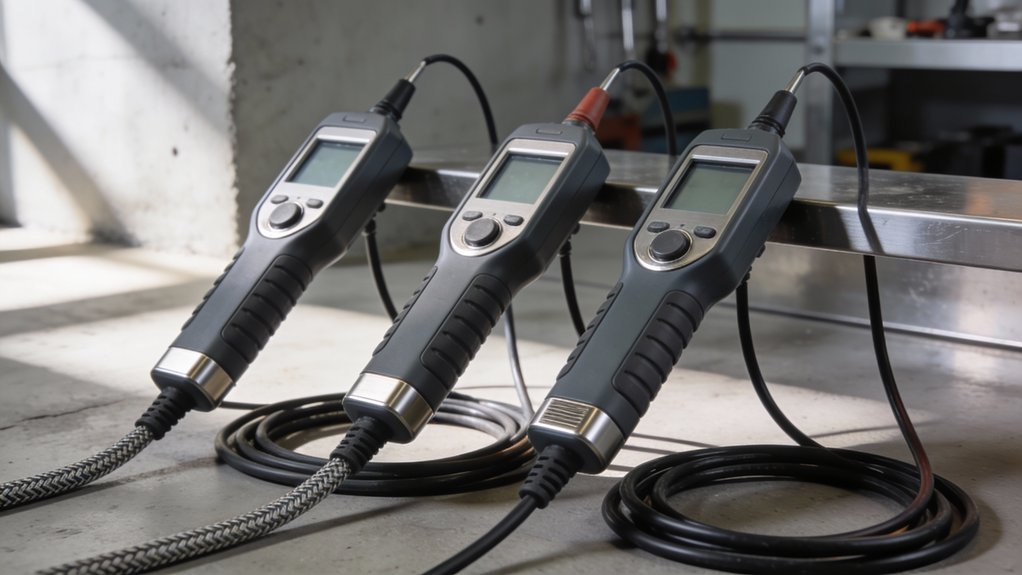
You’ll want to pick an Insulation Tester that matches your home’s wiring needs without overspending on features you won’t use. Look at the test voltage range, safety rating, and accuracy—too low, and you miss risks; too high, and you risk damaging old circuits. A clear display, rugged build, and compact design make testing easier, especially in tight spaces.
Test Voltage Range
Test voltage range
Most insulation testers for home wiring offer a range of test voltages, typically from 50 V to 1,000 V DC, so you can pick the right level for your circuit. You’ll usually use 250 V or 500 V for standard wiring, while 1,000 V helps spot weaknesses in long cable runs or higher-voltage systems. Lower voltages (50–125 V) protect sensitive electronics and short circuits from unnecessary stress. Pick a tester with multiple voltage settings—it gives you flexibility across outlets, appliances, and feeders while meeting code guidelines. Higher voltages reveal hidden flaws, but they can also damage weak insulation, so always use the minimum needed. Remember, readings change with voltage, so note the test level each time. That way, your pass/fail checks and diagnostic tools like PI or DAR stay accurate. Matching voltage to your setup keeps tests reliable—and your home safer.
Safety Rating Level
When working with home wiring, choosing an insulation tester that meets the right safety standards isn’t just smart—it’s essential for staying protected from unexpected electrical surges. You’ll want a tester rated CAT III 600 V or higher, since that means it can handle voltage spikes in household circuits. Always check for live-voltage detection; it stops tests if voltage exceeds 30 V, so you don’t accidentally zap an energized line. Look for models that meet IEC 61010 standards and have third-party safety certifications—they’re tested for real-world risks. Auto-safe features are a big plus, automatically discharging stored energy after each test to protect you and your gear. Pick testers with double insulation and rugged casings designed for up to 600 V systems. These aren’t just extras—they’re smart safeguards every serious DIYer or pro should use.
Measurement Accuracy
Measurement accuracy
A solid safety rating sets the foundation, but accurate measurements determine whether your insulation tests truly reflect the condition of home wiring. You need a tester that reads clearly from 0.1 MΩ to at least 200 MΩ, so you catch both minor leakage and serious faults. Look for stated accuracy like ±(3% + 5 digits)—this tells you how much the reading might vary, especially near safety thresholds. Pick a model with stable responses across common home circuit lengths, using auto-ranging or fixed ranges that reduce user error. Testers with short-term averaging or data hold help smooth out brief fluctuations, so your results stay reliable. Don’t overlook voltage precision: make sure the device delivers accurate 250 V to 1,000 V DC output, since wrong test voltage means wrong readings. You’re not just testing insulation—you’re verifying safety with numbers you can trust.
User Interface Design
Ever tried reading a tiny screen in a dark basement with pipes overhead and your ladder wobbling? You need a large, backlit display showing clear numbers and a high-voltage icon—fast readability cuts mistakes in tight spots. Look for testers with dedicated test and hold buttons so you can run long PI or DAR tests without keeping your finger pressed. A simple pass/fail indicator, like color LEDs or on-screen status, lets you make quick calls on wiring safety without crunching resistance numbers. Smart testers show live-circuit warnings, battery level, and auto-discharge confirmation so you’re never caught off guard. And keep insulation controls—voltage pick, test start, timing—separate from basic multimeter functions. That separation stops accidental mode switches when you’re chasing faults. A clean layout isn’t just nice—it prevents errors when focus slips.
Durability and Portability
Durability and Portability
You’ve seen how a well-designed interface keeps testing simple and safe, even in awkward spots—now think about how well your insulation tester holds up when the job gets rough. You need a rugged tool with an impact-resistant case, ideally rated to survive 1-meter drops. Look for double-insulated or reinforced housing that shrugs off dust, moisture, and scrapes. Portability matters just as much: aim for lightweight models under 1.2 pounds and pocket-friendly sizes so you’re not weighed down. Compact doesn’t mean fragile—many durable testers still slip easily into your bag. Grab one with a protective case or built-in probe storage to avoid damage on the go. Magnetic backs or hanging hooks let you free up hands during checks. Use models with AA or rechargeable batteries offering hundreds of hours so you’re not swapping cells mid-shift. A tough, portable tester stays reliable, day after day.
Conclusion
You’ve seen the top insulation testers, each offering solid performance for home wiring safety. Whether it’s Fluke’s reliability or KAIWEETS’ high-resistance range, there’s a fit for every need. Sure, some lack advanced features, but they get the job done. Can you picture your tools catching a fault before it sparks trouble? Choosing the right one keeps your home—and family—safe. Stay informed, stay safe.