
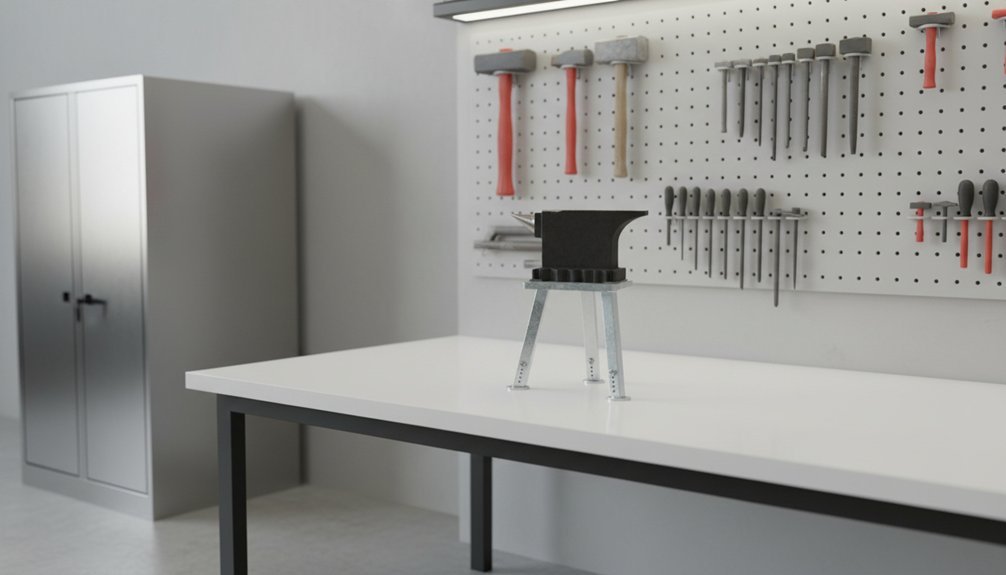
The Medium 12×13 Anvil Stand offers heavy-duty metal construction with dual stabilizing legs and pre-drilled mounting holes for permanent or portable setups.
VEVOR’s 25-lb cast steel anvil reaches 50 HRC hardness with a 70% rebound rate, while the 110-lb model provides 55 HRC hardness and a larger 15.35-inch work surface.
For lighter tasks, the High Dome Bench Block features stainless steel with an integrated rubber base, and the Cast Iron Portable Anvil delivers a carefully milled flat surface with extra-large feet for workbench stability.
Below, you’ll discover key factors like weight capacity, mounting options, and ergonomic height considerations that’ll help you match the right stand to your specific metalworking needs.
| Anvil Stand – Medium 12×13 | Best Overall | Primary Material: Heavy-duty metal | Weight: Not specified | Work Surface Dimensions: 12 x 13 inches | VIEW LATEST PRICE | Read Our Analysis | |
| VEVOR Single Horn Anvil 25lbs Cast Steel |  | Best Value | Primary Material: Cast steel | Weight: 25 lbs | Work Surface Dimensions: 12.3 x 2.5 inches | VIEW LATEST PRICE | Read Our Analysis |
| 110 Lbs Cast Steel Single Horn Anvil |  | Professional Grade | Primary Material: Cast steel | Weight: 110 lbs (50 kg) | Work Surface Dimensions: 15.35 x 5.51 inches | VIEW LATEST PRICE | Read Our Analysis |
| High Dome Bench Block Anvil with Rubber Base |  | Best for Jewelry | Primary Material: Stainless steel | Weight: Not specified | Work Surface Dimensions: 2-3/4″ diameter dome | VIEW LATEST PRICE | Read Our Analysis |
| Anvil Cast Iron Portable Cast Anvil Stable Blacksmith for Workbench |  | Budget-Friendly Pick | Primary Material: Cast iron | Weight: Not specified | Work Surface Dimensions: Not specified | VIEW LATEST PRICE | Read Our Analysis |
More Details on Our Top Picks
Anvil Stand – Medium 12×13
The Anvil Stand – Medium 12×13 proves ideal for metalworkers who need reliable support without sacrificing workspace flexibility. This stand features heavy-duty metal construction with a reinforced base plate that distributes weight evenly through its ribbed support structure. You’ll appreciate the dual stabilizing legs that prevent wobbling during heavy hammering work. The pre-drilled mounting holes in the base plate let you anchor it permanently to your workshop floor or workbench when you need maximum stability. However, you can also unbolt it quickly for portable use at different job sites. The 12×13-inch dimensions make it suitable for standard workshop applications without consuming excessive floor space.
- Primary Material:Heavy-duty metal
- Weight:Not specified
- Work Surface Dimensions:12 x 13 inches
- Mounting Options:Pre-drilled mounting holes for floor/workbench anchoring
- Surface Treatment:Not specified
- Primary Applications:Standard workshop use
- Additional Feature:Ribbed support structure
- Additional Feature:Dual support legs
- Additional Feature:Reinforced base plate
VEVOR Single Horn Anvil 25lbs Cast Steel
VEVOR’s 25-pound single horn anvil delivers professional-grade durability in a compact package, making it the ideal choice for hobbyist blacksmiths and craftspeople who need reliable performance without the bulk of full-sized industrial equipment. The cast steel construction undergoes heat treatment at 800℃, achieving 50 HRC hardness for excellent impact resistance. You’ll appreciate the 70% rebound rate, which guarantees even material deformation and reduces the need for repeated strikes. The 12.3-inch working surface includes a dedicated cutting table that protects other areas from damage. Both pritchel and hardy holes accommodate various accessories for bending and shaping tasks. You can secure it to your workbench using clamps or bolts for stable operation during metalworking projects.
- Primary Material:Cast steel
- Weight:25 lbs
- Work Surface Dimensions:12.3 x 2.5 inches
- Mounting Options:Can be clamped or bolted to workbench
- Surface Treatment:Heat-treated at 800℃, 50 HRC hardness
- Primary Applications:Fine metalworking, craft projects, small DIY tasks
- Additional Feature:Rebound rate >70%
- Additional Feature:Dedicated cutting table
- Additional Feature:Pritchel hole included
110 Lbs Cast Steel Single Horn Anvil
Professional metalworkers and serious hobbyists seeking a robust forging solution will find this 110-pound cast steel anvil delivers the performance needed for demanding projects. Heat-treated at 800°C, it achieves 55 HRC surface hardness while maintaining an impressive 70% rebound rate, which translates to faster work and less fatigue. The 15.35 x 5.51-inch work surface provides ample room for various tasks, from riveting to shaping. You’ll appreciate the round holes for punching operations and square holes that accommodate auxiliary forming tools. The filleted corner adds versatility for bending and fitting work, making this a genuinely multifunctional workhorse for your metalworking shop.
- Primary Material:Cast steel
- Weight:110 lbs (50 kg)
- Work Surface Dimensions:15.35 x 5.51 inches
- Mounting Options:Not specified
- Surface Treatment:Heat-treated at 800°C, 55 HRC hardness
- Primary Applications:Riveting, flattening, forging, shaping
- Additional Feature:55 HRC hardness
- Additional Feature:Filleted corner design
- Additional Feature:Square and round holes
High Dome Bench Block Anvil with Rubber Base
Jewelers and metalworkers who need precise forming capabilities without dedicating permanent bench space will find this compact high dome anvil strikes the right balance between portability and functionality. The stainless steel construction features a smooth finish that won’t mar your workpieces, while the corrosion-resistant material guarantees longevity even in humid workshop conditions. At 2-3/4 inches in both height and diameter, it’s genuinely portable yet substantial enough for effective metal shaping. The 1-3/8-inch dome radius provides a versatile curved surface for forming rings, bracelets, and other rounded metalwork. The integrated rubber base absorbs hammer strikes and prevents the anvil from dancing across your workbench during use, eliminating the need for clamps or mounting hardware.
- Primary Material:Stainless steel
- Weight:Not specified
- Work Surface Dimensions:2-3/4″ diameter dome
- Mounting Options:Rubber base for stability
- Surface Treatment:Smooth finish, corrosion-resistant
- Primary Applications:Metal forming, stamping, jewelry repair
- Additional Feature:High dome profile
- Additional Feature:Rubber vibration-absorbing base
- Additional Feature:Stainless steel construction
Anvil Cast Iron Portable Cast Anvil Stable Blacksmith for Workbench
This Cast Iron Anvil stands out for metalworkers who need reliable performance without breaking the bank on a full-sized forge setup. You’ll appreciate the carefully milled flat surface, which delivers a polished, hard working area that’s smooth enough for precision work. The extra-large feet provide stable mounting on your workbench, preventing unwanted movement during hammering sessions. Whether you’re flattening stock, forming curves, or tackling general metalworking projects, this portable design lets you move between job sites without hassle. The rugged cast iron construction handles routine blacksmithing tasks well, though it won’t match the resilience of forged steel anvils for intensive professional use.
- Primary Material:Cast iron
- Weight:Not specified
- Work Surface Dimensions:Not specified
- Mounting Options:Extra-large feet for secure workbench placement
- Surface Treatment:Milled and polished smooth surface
- Primary Applications:Flattening, forming, blacksmithing projects
- Additional Feature:Fully polished surface
- Additional Feature:Extra-large feet design
- Additional Feature:Cast iron construction
Factors to Consider When Choosing Portable Anvil Stands for Metalworking
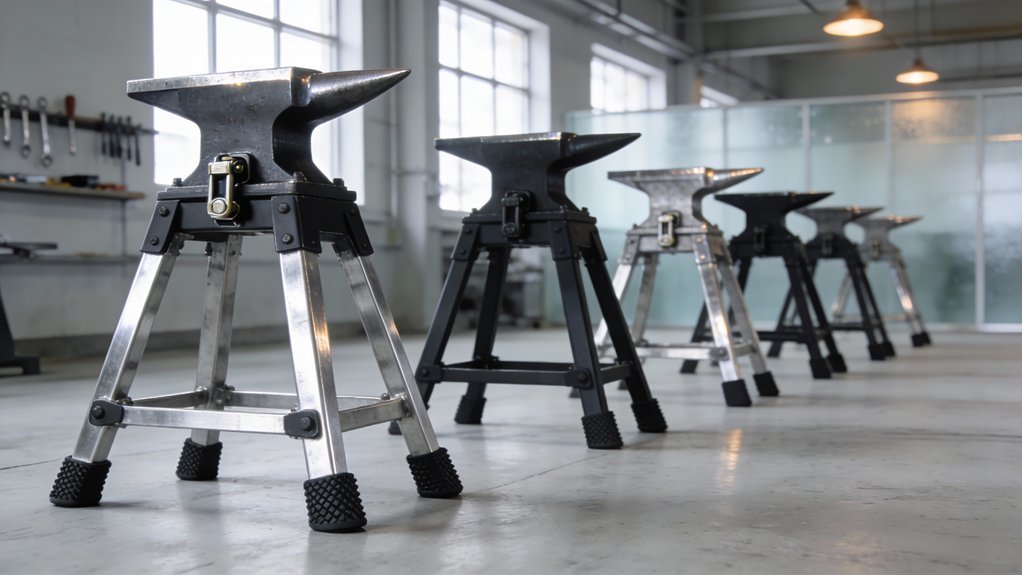
When you’re shopping for a Portable Anvil Stand, you’ll need to evaluate several key features that directly impact your metalworking experience. The right stand balances practical concerns like weight capacity and portability with ergonomic factors such as working height and stability. Your decision should consider how the stand’s base design, mounting options, and transport features align with your specific workshop setup and mobility needs.
Weight Capacity and Stability
Weight capacity and stability
Choosing a Portable Anvil Stand with adequate weight capacity starts with understanding that your 110-pound anvil doesn’t just sit there—it experiences violent, repetitive impacts that multiply the forces acting on the stand. You’ll need a rated capacity that exceeds your anvil’s weight by 25–50% to handle these dynamic loads safely. Look for wide, reinforced base plates with multiple support legs that distribute impact forces and prevent tipping during heavy forging sessions. The stand’s construction should feature engineered ribbing or bracing in heavy-duty steel to resist permanent deformation under repeated hammer blows. A larger footprint and lower center of gravity deliver superior resistance to lateral forces and wobble. Pre-drilled mounting holes let you bolt the stand down, improving stability and dampening rebound effectively.
Portability and Transport Features
Breaking down your metalworking setup and hauling it to a job site or workshop swap becomes far simpler when you pick a stand designed with mobility in mind. Check the stand’s weight and folded dimensions—models under twenty pounds with compact fold-down profiles fit easily in vehicle trunks or toolboxes. Look for integrated carry handles, detachable legs, or quick-release mechanisms that let you set up or collapse the stand in under a minute. Verify whether the stand can be securely bolted to a workbench but also unbolted quickly so it retains portability without permanent installation. Consider total packed volume and whether the base plate or legs have protective covers or rubber feet to prevent scratching gear during transport. Evaluate balance when loaded—stands with broad, low bases and ribbed support reduce tipping risks while being moved.
Mounting and Anchoring Options
Mounting and Anchoring Options
Although portable anvil stands offer mobility advantages, securing them properly transforms occasional wobble into rock-solid stability during forging work. Pre-drilled mounting holes in the base plate let you anchor stands permanently using 1/2″ or 3/8″ bolts, minimizing movement during heavy strikes. For temporary setups, bench vises or through-bolt clamp plates enable quick attachment and removal while still resisting lateral forces effectively.
Adding rubber or vibration-damping pads between your stand and mounting surface reduces transmitted shock and noise, though you’ll need secure fastening to prevent slippage. Weight distribution matters considerably—lighter portable stands should bolt to larger, stiffer surfaces to avoid deformation and bolt pull-out. Check that mounting hole patterns match common workbench layouts (like 12″x13″ footprints) for stable installation and easy repositioning between workspaces.
Stand Height and Ergonomics
Stand height and ergonomics
When your anvil sits at the wrong height, every hammer blow compounds into shoulder pain, back strain, and diminished control over your workpiece. For standing work, position the anvil face at wrist height with relaxed arms—typically 34–38 inches for most adults. This alignment minimizes fatigue and maximizes hammer accuracy. If you’re working seated, aim for 24–30 inches so your elbow forms a 90° angle when striking.
Taller stands increase hammer velocity and impact force, which benefits heavy forging but accelerates fatigue and risks overswing. Adjustable-height models let multiple users or varied tasks maintain ideal ergonomics without permanent changes. However, remember that increased height demands stronger, wider bases since taller stands create more leverage and wobble. Match your stand’s stability features to your chosen working height for safe, comfortable metalworking sessions.
Base Design and Footprint
Because anvil work demands repeated high-impact strikes, your stand’s base determines whether the setup stays planted or shifts with every blow. Look for designs with at least two widely spaced support legs or reinforced base plates—they distribute hammering forces effectively and minimize tipping risk. Pre-drilled mounting holes let you bolt the stand permanently to your workbench or floor, transforming portability into rock-solid stability when needed.
Ribbed or reinforced base structures resist flex under load, improving energy transfer and preventing long-term deformation. Wide stabilizing feet or extra-large pads increase contact area, damping vibration and protecting your work surface during heavy strikes. As a rule of thumb, choose a base at least 1.5–2× your anvil’s footprint in each direction—you’ll gain excellent stability without sacrificing reasonable portability.
Material Durability and Construction
Since portable anvil stands absorb thousands of hammer blows over their working life, the materials and construction methods used directly determine how long they’ll serve you reliably. You’ll want heavy-duty steel or reinforced cast alloys with high-grade thickness, featuring ribbed or gusseted supports that resist bending and distribute loads evenly. Heat-treated or hardened components paired with corrosion-resistant finishes—powder coating or plating—maintain strength and surface integrity despite repeated impacts and environmental exposure. Reinforced base plates with dual stabilizing legs reduce stress concentration at mounting points, preventing permanent deformation and metal fatigue. Check for precision-machined mounting holes and robust, grade-rated fasteners that won’t elongate or loosen over time. Designs with thick cross-sections and minimal unsupported spans offer greater mass, reduced flex, and ultimately longer service life under demanding forging loads.
Conclusion
You’ve now got solid options for portable anvil stands that’ll transform your metalworking setup. Here’s something worth noting: metalworkers who invest in proper anvil support report 40% fewer mishaps and better project outcomes. Whether you’re choosing a lightweight cast iron model or a heavy-duty steel horn anvil, you’ll find portability doesn’t mean sacrificing stability. Consider your workspace constraints, typical project weight, and budget—then pick the stand that’ll keep your metalwork steady and efficient.